by COWBERRY

7 minute read
Barnyard millet vs foxtail millet: names, taste and which to choose

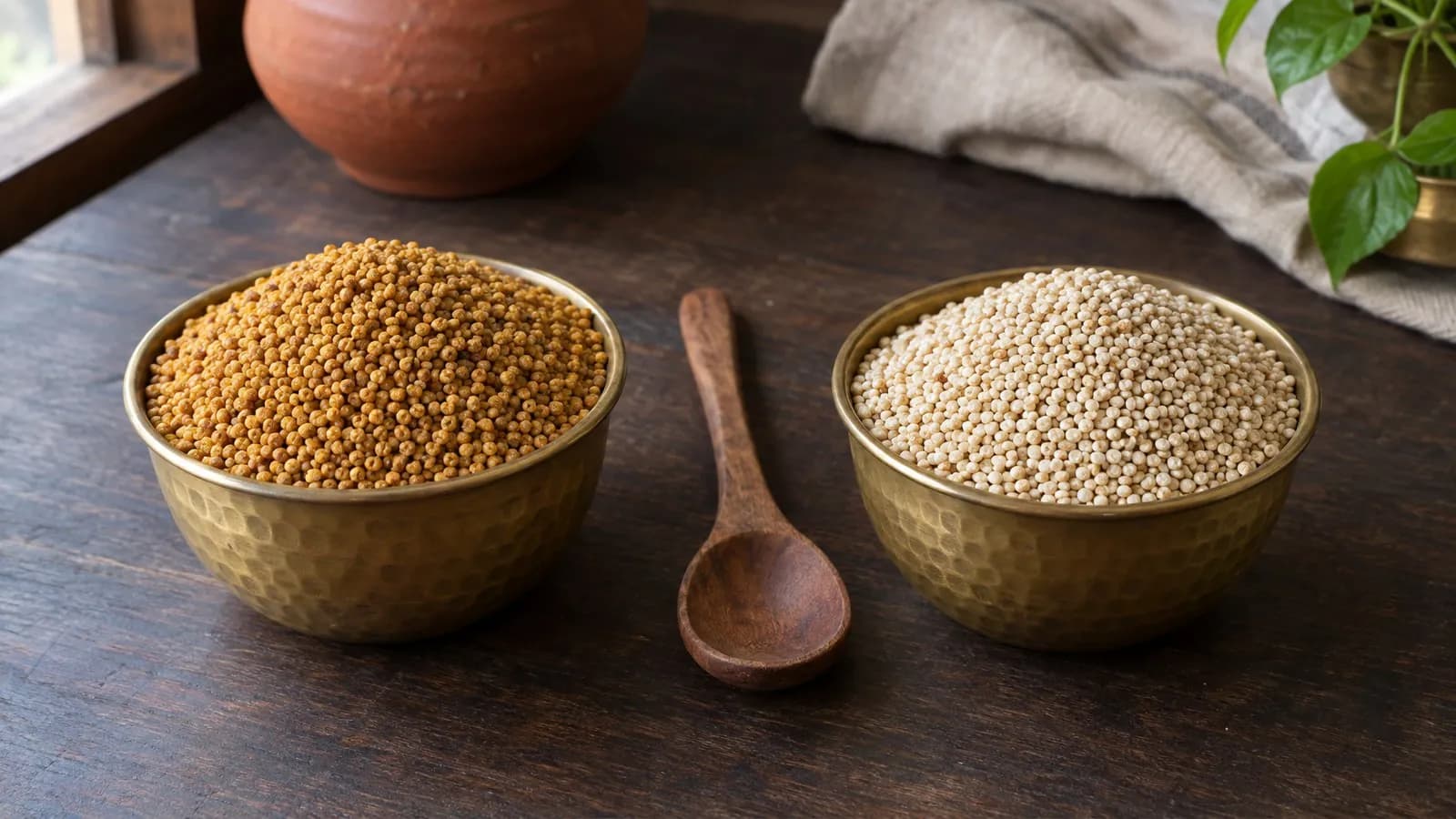
Barnyard millet vs foxtail millet in one line: two different small millets. Barnyard is the Echinochloa grain sold as sanwa and oodalu; foxtail is Setaria italica, the kangni and korra grain. Names, nutrition, glycemic index, taste and which to choose are below; the grain itself is on the barnyard millet hub page.
Verdict in three lines
Two different grains. Barnyard millet is an Echinochloa and foxtail millet is Setaria italica, which ICAR-IIMR regards as a native of China and one of the world's oldest cultivated crops. Their Indian names never overlap: sanwa against kangni, oodalu against navane, udalu against korra.
Both are small millets. The same review groups them with finger millet, little millet and proso millet among the small millets of India's dry southern and central states, and neither grain has an entry in IFCT 2017 or a matching one in USDA FoodData Central, so no per-100 g numbers appear below.
If you must pick by the test, foxtail has the numbers. It carries one India-tested GI entry, 89 for unpolished grain, plain cooked; barnyard has no entry in that database. What barnyard has instead is a description: carbohydrate that the ICAR-IIMR review calls low and slowly digestible.
The foxtail millet hub covers the kangni grain on its own.
Barnyard millet vs foxtail millet: names and GI side by side
Both grains' names come from the two ICAR-IIMR lists, the millets information web page and the PDF 'Nutritional and health benefits of millets'; the GI figure is the India-tested entry from the University of Sydney GI database. The full barnyard name list, with a note under each name, is on barnyard millet in English, Hindi and Indian languages.
| Barnyard millet | Foxtail millet | |
|---|---|---|
| English name | Barnyard millet | Foxtail millet, Italian millet |
| Botanical name | Echinochloa crusgalli | Setaria italica |
| Hindi | Sanwa, Jhangon | Kangni, Kakum |
| Gujarati | Sama | Kang |
| Marathi | Shamul | Kang, Rala |
| Punjabi | Swank | Kangni |
| Bengali | Shyama, Shamula | Kaon |
| Odia | Khira | Kanghu, Kangam, Kora |
| Kannada | Oodalu | Navane |
| Telugu | Udalu, Kodisama | Korra, Korralu |
| Tamil | Kuthiraivolly, Kuthiravaali | Tenai |
| Malayalam | no name recorded | Thina |
| Sanskrit | Shyama | Kanguni |
| Glycemic index | no entry | 89 (unpolished, plain cooked, India) |
The last row carries the point of this page: foxtail has a measured GI and barnyard does not. Every other row shows the two grains keeping separate names in every language.
Nutrition and glycemic index of the two millets
IFCT 2017 has no barnyard millet or foxtail millet entry (its A017 Varagu is kodo millet), and USDA FoodData Central's 'Millet, raw' is proso millet, a third grain. So no per-100 g figures appear for either millet, and no other cereal's numbers stand in for them.
The one measured figure is foxtail's. The University of Sydney GI database has a single India-tested entry for foxtail millet, GI 89, on unpolished grain, plain cooked (Malavika et al., Indian J Med Res, 2020); in that study the unpolished foxtail and little millet both came out in the high GI category. The study's market finding is worth knowing: most of the millet samples bought for it were highly polished grains, and most participants (12 of 20) did not know that millets can be polished like rice.
Barnyard millet has no GI entry in the database, so its nutrition is on record only in words. ICAR-IIMR describes highly digestible protein, excellent dietary fibre with soluble and insoluble fractions, carbohydrate that is low and slowly digestible, linoleic acid as the major fatty acid, and a starch that retrogrades, so the resistant starch share rises. The same review says the grain can be potentially recommended for patients with cardiovascular disease and diabetes mellitus. A 2023 review adds that barnyard millet is rich in micronutrients, fibres and phytochemicals, and that its gluten-free flour can be incorporated into the diet of celiac and diabetic patients.
For scale, the University of Sydney classes 55 and below as low GI and 70 and above as high, which puts foxtail's 89 in the high band.
Taste and cooking of the two millets
None of the published sources records a taste profile for either grain, so no taste notes are given. What they do record is the form in which the grain reaches the plate.
The sharpest note is about polish. The 2020 Chennai study found most minor millet samples on the market were highly polished grains, and the GI it reports is for unpolished grain, plain cooked, so a glossy pack is not the tested form.
On uses, the 2023 review lists barnyard millet products from bread, snacks and baby foods to porridge, fast foods and millet nutrition powder; ICAR-IIMR says foxtail's grain goes to human consumption and to poultry and cage bird feed.
Once cooked, either millet follows the leftover rule: keep it in the fridge for up to two days (UK Food Standards Agency). Cooking basics for the sanwa grain are on the barnyard millet hub page.
Cost and where each fits
No published price list covers these two grains, so cost is left to the shelf. Where each grain fits is better documented.
In the ICAR-IIMR account, foxtail millet ranks second in total world millet production, grows from sea level to 2000 m, cannot tolerate water logging and is fairly tolerant of drought, escaping some droughts through early maturity; its quick growth makes it a short-term catch crop.
Barnyard millet is the multi-purpose crop of the pair, grown for food and fodder together, with multiple harvests in a year per the 2023 review, and that review flags its susceptibility to biotic and abiotic stresses.
In the kitchen, foxtail has the tested GI (a high one) and barnyard has the recorded descriptions: the slowly digestible carbohydrate and the gluten-free flour. If you manage diabetes, ask your doctor or dietitian which suits you.
Which for whom
- Diabetes: foxtail has the only database entry, GI 89 in the high band, on unpolished grain plain cooked in India. Barnyard has no GI entry in the database; ICAR-IIMR records its carbohydrate as low and slowly digestible and says it can be potentially recommended for patients with diabetes mellitus. Neither replaces the meal plan; check with your doctor or dietitian.
- Celiac and gluten-free diets: barnyard's flour is gluten-free and a 2023 review says it can be incorporated into celiac diets. The ICAR-IIMR review gives the gluten-free line for millets as a group, foxtail included.
- The kitchen: barnyard has a recorded product list, from porridge to baby foods; foxtail has the tested cooking form, unpolished and plain cooked.
- Storage: the same for both: up to two days in the fridge once cooked.
- Anyone weighing the two: the wider picture on what the sanwa grain does and does not do is on barnyard millet benefits.
FAQs
Is foxtail millet and barnyard millet same?
No. Barnyard millet is an Echinochloa grain and foxtail millet is Setaria italica, and their Indian names never overlap: sanwa and oodalu against kangni and navane. ICAR-IIMR lists them as two species among the small millets, and the single India-tested GI entry, 89 on unpolished grain plain cooked, belongs to foxtail; barnyard has none.
Difference between barnyard millet and foxtail millet?
Species, names and GI. Barnyard millet is Echinochloa crusgalli; foxtail millet is Setaria italica. Names: sanwa, oodalu and udalu against kangni, navane and korra. GI: foxtail has an India-tested entry of 89 (unpolished, plain cooked); barnyard has no entry, and for it the ICAR-IIMR review records carbohydrate that is low and slowly digestible instead of a number.
Is barnyard millet good for diabetes?
The University of Sydney database has no GI entry for barnyard millet, so no number is claimed. ICAR-IIMR records its carbohydrate as low and slowly digestible and says the grain can be potentially recommended for patients with diabetes mellitus, and a 2023 review notes its gluten-free flour can be incorporated into diabetic diets. Portion and the doctor's advice still rule.
Does barnyard millet have carbs?
Yes, like every cereal; the ICAR-IIMR review puts its carbohydrate on record as low and slowly digestible. Neither IFCT 2017 nor the USDA food tables carries a per-100 g value for this grain, so no figure is quoted. The same review records that the starch retrogrades and the resistant starch share rises.
Why barnyard millet?
Because its published descriptions line up: highly digestible protein, excellent dietary fibre with soluble and insoluble fractions, slowly digestible carbohydrate and a gluten-free flour, all on record with ICAR-IIMR and a 2023 review. The 2023 review also lists products, from porridge and bread to baby foods and nutrition powder.
References
- USDA FoodData Central
- Indian Food Composition Tables (IFCT) 2017, ICMR-National Institute of Nutrition
- University of Sydney glycemic index database (GI search)
- University of Sydney: about the glycemic index
- ICAR-Indian Institute of Millets Research: millets information and vernacular names
- Nutritional and health benefits of millets, ICAR-Indian Institute of Millets Research (PDF)
- Bhatt D, Rasane P, Singh J, et al. Nutritional advantages of barnyard millet and opportunities for its processing as value-added foods. J Food Sci Technol, 2023
- Malavika M, Shobana S, Vijayalakshmi P, et al. Assessment of quality of minor millets available in the south Indian market & glycaemic index of cooked unpolished little & foxtail millet. Indian J Med Res, 2020
- UK Food Standards Agency: How to chill, freeze and defrost food safely
Keep reading
Foxtail millet vs quinoa: nutrition, taste and which to choose
Foxtail millet in Kannada, Hindi, Tamil and other Indian names
10 benefits of kangni (foxtail millet) and its side effects