by COWBERRY

10 minute read
What is moongfali? Peanuts (groundnut): names, nutrition, how to eat

What is peanuts, the nut Indians call moongfali? It is the groundnut, Arachis hypogaea, the nut IFCT 2017 records under the English name Ground nut, and it delivers 521 kcal, 23.65 g of protein and 10.38 g of fibre per 100 g, with a glycemic index of 11. This guide collects its names, nutrition, benefits, recipes and buying advice in one place.
What is peanuts? The short answer
What is peanuts, asked the other way round, is what is the groundnut: one nut under two everyday English names, recorded in IFCT 2017 as Ground nut and known in common use as the peanut. Its scientific name is Arachis hypogaea, and a 2016 review calls the peanut an important crop grown worldwide. In Indian kitchens it is moongfali — roasted, boiled plain and ground into chutneys — and pressed, the same nut gives groundnut oil, Moongphali ka tel in Hindi. The peanuts in hindi page sorts the 13 names; nutrition, benefits, cooking and buying follow below.
Groundnut names in Indian languages
IFCT 2017 carries 13 names for the groundnut: the English Ground nut, one name in each of 12 Indian languages, and no Sanskrit entry in the row. Hindi, Punjabi and Urdu share Moog phali. In the west, Gujarati's Singdana and Marathi's Bhui mug; in the east, China badam for Bengali and Odia and Badam for Assamese; in the south, Kannada's Kadale kayi, Telugu's Verusenaga, Tamil's Verkadalai and Malayalam's Nilakkadalai. The table below carries that list, with everyday spellings — moongfali, mungfali, kadalekayi — noted under it, and the same list gives the oil two names too: Moongphali ka tel in Hindi, Shengdana tel in Marathi. The peanuts in hindi page answers the name confusions one by one, from badam to singdana.
| Language | Name (romanised) |
|---|---|
| English | Ground nut |
| Hindi | Moog phali, Moongfali, Mungfali |
| Marathi | Bhui mug |
| Gujarati | Singdana |
| Punjabi | Moog phali |
| Bengali | China badam |
| Odia | China badam |
| Assamese | Badam |
| Kannada | Kadale kayi, Kadalekayi |
| Telugu | Verusenaga |
| Tamil | Verkadalai |
| Malayalam | Nilakkadalai |
| Urdu | Moog phali |
| Sanskrit | — |
| Botanical name | Arachis hypogaea |
Source: IFCT 2017 (ICMR-NIN) local-names list. — means no name recorded in the source.
Hindi ‘Moongfali’: spelling variant of the IFCT 2017 name ‘Moog phali’. Hindi ‘Mungfali’: spelling variant of the IFCT 2017 name ‘Moog phali’. Kannada ‘Kadalekayi’: spelling variant of the IFCT 2017 name ‘Kadale kayi’.
Peanuts nutrition per 100 g at a glance
The numbers that matter, from IFCT 2017: energy 521 kcal, protein 23.65 g, fat 39.63 g, carbohydrate 17.27 g and fibre 10.38 g per 100 g, with a glycemic index of 11 — the mean of five database readings that range from 5 to 23, none from India. The table below sets the groundnut beside sesame seeds and kabuli chana for context.
A 30 g handful carries 156 kcal, 7.1 g of protein and 3.1 g of fibre. A full cup of groundnuts is 140 g — that cup carries 729 kcal and 55.5 g of fat, so the cup stays a cooking measure. For the mineral rows, the whole table and the boiled-versus-roasted question, the peanuts nutrition page goes number by number.
Raw groundnuts are dense: the energy comes mostly from the fat, with the protein close behind, so the numbers rise quickly with the portion. Cooked forms stay close to these numbers when nothing extra is added; salt, oil and jaggery are what move them. For quick reference while cooking: sesame seeds carry 520 kcal and kabuli chana 378 kcal per 100 g, so the groundnut is the energy-dense one of the three, which is useful to know when a recipe swaps one for another.
| Nutrient | Groundnut (peanut), raw | Sesame seeds (white) | Kabuli chana |
|---|---|---|---|
| Energy (kcal) | 521 | 520 | 378 |
| Protein (g) | 24 | 22 | 20 |
| Fat (g) | 40 | 43 | 6 |
| Carbohydrates (g) | 17 | 11 | 63 |
| Dietary fibre (g) | 10 | 17 | 12 |
| Iron (mg) | 3.4 | 15 | 4.3 |
| Calcium (mg) | 54 | 1283 | 57 |
| Magnesium (mg) | 197 | 372 | 79 |
| Potassium (mg) | 679 | 460 | 718 |
| Sodium (mg) | 12 | 15 | 24 |
| Zinc (mg) | 3.2 | 7.8 | 2.8 |
| Folate (mcg) | 91 | 131 | 557 |
| Vitamin C (mg) | — | — | 4 |
| Glycemic index (GI) | 11 | — | 23 |
Per 100 g raw, edible portion. Composition: IFCT 2017 (ICMR-NIN); USDA FoodData Central (SR Legacy), FDC ID 173756, NDB 16056. GI: University of Sydney GI database. — means not reported. These are average values for the food; the label on a pack gives the values for that product.
Peanut benefits and side effects: the short version
The benefit story in two lines: 23.65 g of protein per 100 g with the full set of 20 amino acids, and 10.38 g of fibre that adds satiety. On trial measures, 13 randomised trials found HDL up by 2.72 mg/dl (P=0.001) with the other cholesterol lines steady, and the weight, waist and BMI numbers equally unmoved, filling as the nut is. The minerals add the third line: 197 mg of magnesium and 679 mg of potassium per 100 g, with 3.44 mg of iron and 90.87 mcg of folate.
A 2016 review adds the nut's own chemistry — phytosterols, resveratrol, phenolic acids and flavonoids can hold back some of the cholesterol the diet absorbs, and the peanut is a good source of co-enzyme Q10. On the plate, the guidelines count satiety twice over: fats bring fullness and put off the next hunger pang, while the fibre adds to it. The full account, with the boiled-versus-roasted detail, is on the peanut benefits and side effects page, and the moongfali khane ke fayde page carries the same story in Hindi.
Peanuts for diabetes and weight: the trial numbers
Groundnuts sit at GI 11, deep in the low band, and the trials back that reading. Fasting blood sugar and insulin barely moved in those trials (0.57 mg/dl, P=0.604, and -0.40, P=0.582), and the weight numbers were equally flat. By the database's own bands, a GI of 55 or below is low and 70 or above is high, so the nut sits comfortably in the low band, where a low rating means gentler swings in blood glucose than high-rated foods; the five GI readings come from the Philippines, South Africa, Canada and Mexico, none from India.
The guidelines' explanation for the calm numbers is fullness: they describe fibre as slowing the uptake of carbohydrate and fat, and fats as stretching the gap to the next meal. A measured handful fits a weight-conscious day on that logic, not as a weight-loss trick. The two pages that walk through these numbers in full are peanuts for diabetes and peanuts for weight loss.
Peanut side effects, and peanuts for babies
The serious caution is allergy. Peanuts sit among the common allergy-causing ingredients the guidelines name, and reactions can be severe, so anyone with a past reaction should avoid the nut entirely and follow a doctor's plan.
For babies the modern advice runs the other way. In the 2015 LEAP trial of 640 infants with severe eczema, egg allergy, or both, early peanut consumption left the five-year allergy figure at 1.9% against 13.7% with avoidance where the skin-prick test was negative, and at 10.6% against 35.3% where it was positive; serious adverse events showed no meaningful gap between the groups. The guidelines advise giving each new food on four to five consecutive days and watching for intolerance or allergy; their menu for 9-12-month-olds already lists 5 g of groundnut a day. Anyone introducing peanuts to a baby should keep the doctor in the loop, since a family history of allergy changes the advice.
The everyday cautions: salted and coated packs pile on things the plain nut lacks, and the 140 g cup at 729 kcal is far beyond a snack. Preparation matters on the benefit side too — a 2016 review finds that roasting and boiling both raise the nut's bioactives. If you live with a heart condition or diabetes, check with your doctor or dietitian before changing what you eat.
How to eat peanuts: roast, boil and snack
The guidelines put roasted and boiled peanuts on their list of nutritious snack options, and boiling earns a headline of its own: it can lift the antioxidant concentration up to four times over the raw and roasted forms. Dry-roast kernels in a pan until crisp, or boil them plain — both forms hold to the raw nutrition figures; the coatings, oil and jaggery are what add on top.
For the daily amount, the guidelines' vegetarian My Plate sets nuts and seeds a shared 35 g each day — about 182 kcal — and a 30 g handful at 156 kcal fits inside it. The guidelines' own words apply: be mindful of portion sizes. Roasted peanuts meet jaggery in the chikki recipe below, and a sealed jar in a cool, dry place keeps the plain nut for weeks. Each recipe that follows starts from this plain base and carries its own step list and serving numbers.
Peanut recipes to start with
Four recipes built on the same raw nut. Masala peanuts toss 210 g of groundnuts with besan and spices and roast them into six small bowls at 216 kcal and 9.4 g of protein each, no frying, crisp in a sealed jar for about a week. Peanut chikki sets the roasted nut with jaggery — 140 g of peanuts to 150 g — into sixteen squares at 169 kcal per two. Moongfali laddu rolls the pair into twelve soft laddus at 119 kcal each, and moongfali chutney grinds the nut into a dosa-side chutney at 57 kcal per two tablespoons. All four start from the same 521 kcal per 100 g raw nut, and each recipe carries its full step list and per-serving numbers.
For where each belongs: the chikki and laddus travel well in tins, the chutney is a dosa-and-idli breakfast side, and the masala peanuts are the jar that lives on the shelf for tea time.
How to buy and store groundnuts
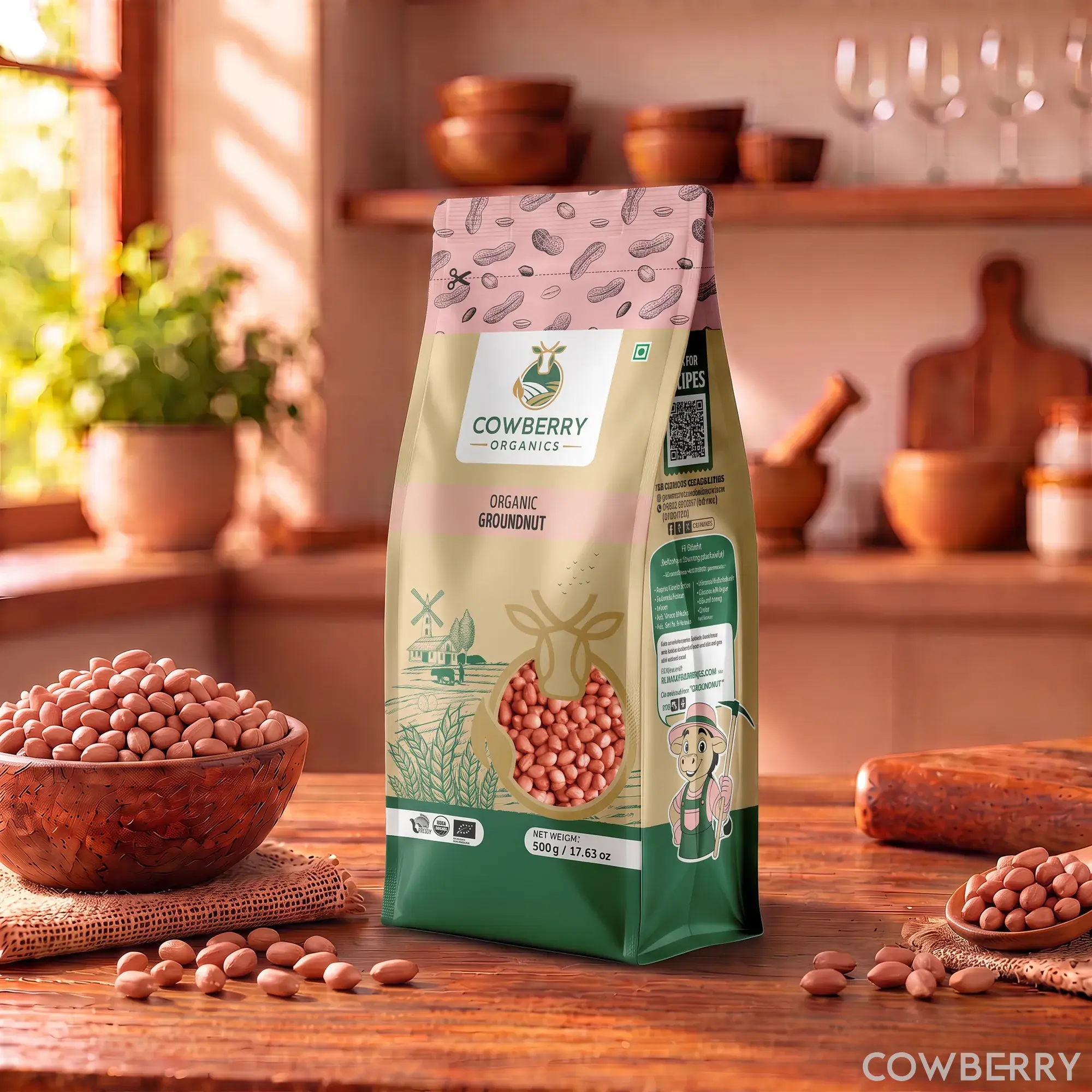
Buy plain — raw or dry-roasted, without salt or sugar coatings — and roast at home when you want them warm. Whole kernels and split forms cook the same; only salted, flavoured packs change the numbers above, and those are the ones to leave on the shelf. COWBERRY's Organic Groundnuts (Peanuts) come from Saurashtra (Gujarat) and Andhra Pradesh, farmed with cow-based natural methods, handpicked and sun-dried, and carry the India Organic, USDA & EU certified line. The product name itself pairs the two words — Organic Groundnuts (Peanuts) — and the pack is Non-GMO, free of additives and preservatives, vacuum-sealed to keep the nuts fresh. Store the jar airtight in a cool, dry place away from the stove's heat, and the nuts stay fresh for weeks.
FAQs
What is peanuts?
The groundnut: Arachis hypogaea by its scientific name, Ground nut in the IFCT 2017 name list, and moongfali in everyday Hindi. Peanut is the common English word for the same nut.
What is moongfali?
Hindi for the groundnut — IFCT 2017 records the Hindi name as Moog phali, with moongfali and mungfali as its everyday written forms; in English the nut is the groundnut or peanut. The names table above lists all 12 Indian languages.
What is peanuts rich in?
Protein, fat and fibre — 23.65 g of protein, 39.63 g of fat and 10.38 g of fibre per 100 g, with magnesium at 197 mg and potassium at 679 mg. The nut also carries the full set of 20 amino acids, led by arginine. Energy is 521 kcal per 100 g, so portions matter.
Can I eat peanuts everyday?
Yes, within the portion: the guidelines give nuts and seeds a 35 g share in the vegetarian My Plate — about 182 kcal — and a 30 g handful at 156 kcal fits inside it. Keep the rest of the day as usual.
How much peanuts can you eat in a day?
About a 30 g handful — 156 kcal — with the guidelines setting the nuts-and-seeds share at 35 g, roughly 182 kcal. A full cup is 140 g and 729 kcal, which is a cooking measure rather than a daily amount.
Can peanuts increase cholesterol?
The trials show the opposite direction: in 13 randomised trials, HDL went up by 2.72 mg/dl (P=0.001), with the LDL, triglyceride and total-cholesterol numbers hardly moving. The nut's phytosterols may hold back some of the cholesterol the diet absorbs.
Why peanuts are bad for you?
For a few people, allergy: peanuts sit on the guidelines' list of common allergy-causing ingredients, alongside milk, fish, eggs and tree nuts, and reactions can be severe. For everyone else the cautions are salted, fried and coated packs, and the 729 kcal a full cup carries.
Which peanuts are best?
Plain roasted or boiled ones — the two forms the guidelines name among their nutritious snack options, and boiled ones carry up to four times the antioxidant concentration of raw and roasted ones. Skip the salted, fried and jaggery-coated packs in favour of the plain forms, whatever the variety.
References
- Indian Food Composition Tables (IFCT) 2017, ICMR-National Institute of Nutrition
- Dietary Guidelines for Indians, ICMR-National Institute of Nutrition
- University of Sydney glycemic index database (GI search)
- University of Sydney: about the glycemic index
- Arya SS, Salve AR, Chauhan S. Peanuts as functional food: a review. J Food Sci Technol, 2016
- Jafari Azad B, Daneshzad E, Azadbakht L. Peanut and cardiovascular disease risk factors: A systematic review and meta-analysis. Crit Rev Food Sci Nutr, 2020
- Du Toit G, Roberts G, Sayre PH, et al. Randomized trial of peanut consumption in infants at risk for peanut allergy. N Engl J Med, 2015
Shop this article
Keep reading
Coriander water benefits: what dhania water actually does
Peanuts in Hindi (moongfali): groundnut names in Indian languages
Coriander vs cilantro: are they the same herb?